


Custom RF Filters
Designed and built to your specifications
Spectrum Control’s low-loss (0.1 dB) bandpass filter designs surpass other RF filter companies, with every filter tested to your exact specifications. These industry-leading solutions are also available as lowpass, highpass, and notch filters using lumped element, cavity, ceramic, SAW, printed, and new glass filter topologies.
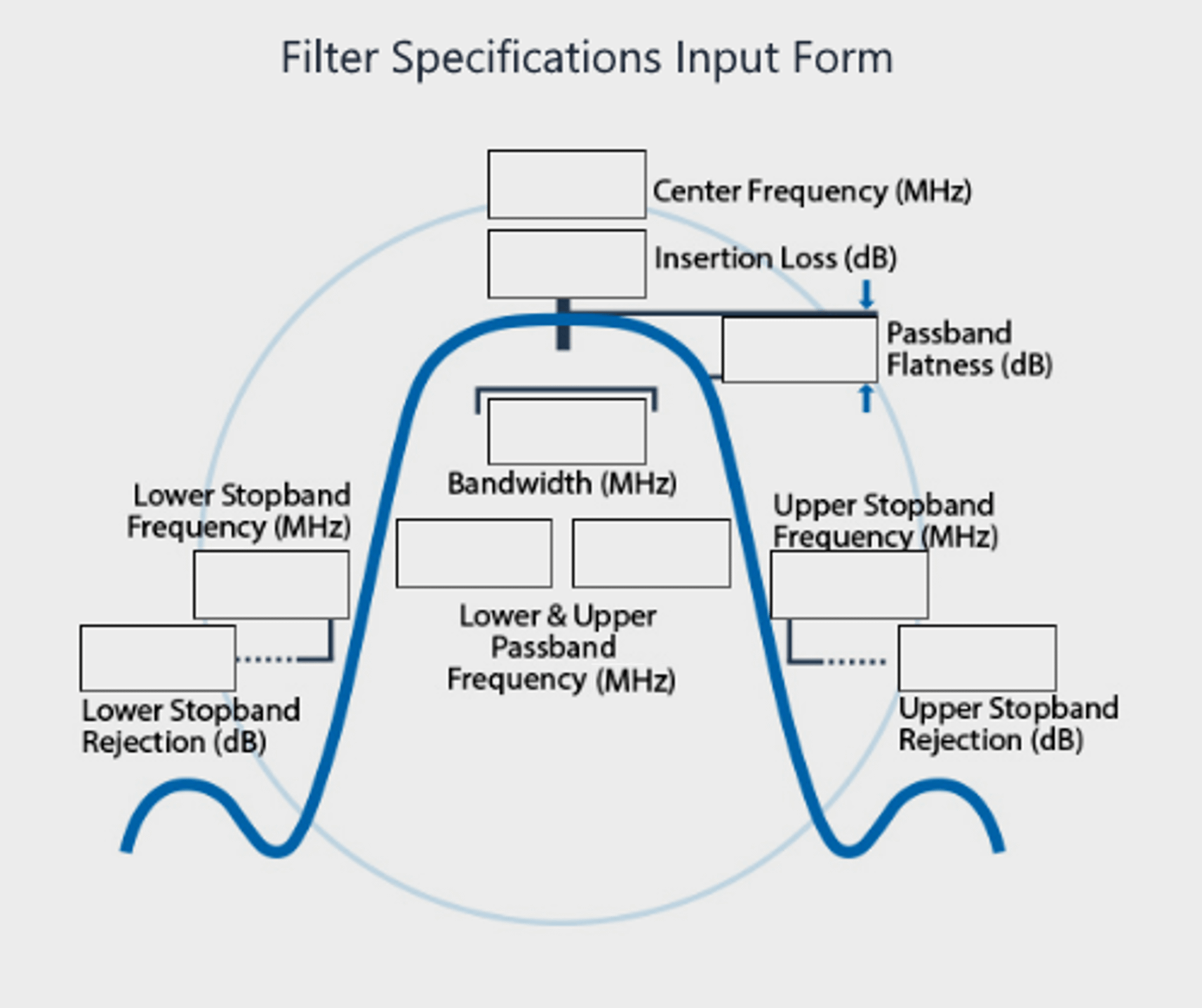
Specify your custom RF filter using our convenient input form.
Low insertion loss filters (0.1 dB) are essential for many of today’s defense platforms and modern wireless environments that require high spectral fidelity. Low insertion loss filters (0.1 dB) help receivers detect and process low-power targets, as well as discern targets of interest in interference-heavy environments. Spectrum Control offers 0.1 dB loss bandpass filters to help identify weak communication transmissions and recognize valuable intelligence signals in a crowded spectrum.
Spectrum Control's database of low-loss bandpass filter designs (0.1 dB) helps eliminate the need for additional gain when Size, Weight, and Power (SWaP) initiatives are in place. Low-loss filters from Spectrum Control also help suppress harmonics at the receiver front end when complex pulse or chirp signals are cascaded in the receive-side chain. This is especially critical where a flat amplitude response helps prevent distortion and unwanted spurious modulation.
Spectrum Control’s line of low-loss bandpass filter designs (0.1 dB) delivers insertion loss as low as 0.1 dB while optimizing pole-placement strategies to achieve high rejection in a compact design. These low-loss bandpass filters (0.1 dB) also help maintain receiver sensitivity in crowded wireless spectra. High insertion loss can lead to excessive heat, requiring additional cooling strategies or heavier metal packaging to prevent thermal runaway.
Low-loss bandpass filters (0.1 dB) from Spectrum Control improve signal-to-noise ratio (SNR) performance by providing a lower-loss path for weak signals, maintaining spectral purity without harmful bit-error-rate (BER) degradation. Spectrum Control also offers a selection of Rapid Filter options, providing bandpass filters in both Chebyshev and Elliptic functions to meet critical demand requirements.